Understanding Roast Levels in Oolong (焙火)
The Label That Nobody Explains
You’re on a vendor site looking at three Tieguanyins. One is “light roast,” one is “medium roast,” one is “traditional charcoal roast.” They cost about the same. Nothing tells you which one you’d actually enjoy.
Roast — bei huo (焙火), literally “baking fire” — is the step that decides most of what you’ll taste in an oolong. It happens after the leaf is already finished as tea: the maker applies sustained low heat over hours or days, driving off residual moisture and pushing the leaf’s sugars and amino acids into caramelization. Floral turns to fruit; fruit turns to toast, nut, and cocoa.
Roast Is Not Oxidation
This is the single most common mix-up, and it makes vendor listings unreadable until you separate the two.
Oxidation happens to the fresh leaf, early, while it is being bruised and rested. It is what makes a tea green, oolong, or red in the first place. Roasting happens later, to already-made tea, with heat.
A tea can be lightly oxidized and heavily roasted. Some traditional Tieguanyin is exactly that. So when a listing says “dark oolong,” ask which knob was turned — the color of the dry leaf alone won’t tell you.
The Five Levels
Fujian producers generally name five steps along the roast continuum. Treat them as rough ranges, not strict grades — the same label from two vendors can differ.
| Level | Chinese | What it tastes like |
|---|---|---|
| Very light | 微火 | Clean and fresh; roast is nearly invisible, aroma reads raw and green |
| Light | 轻火 | Floral and green character still leads, with a faint warmth behind it |
| Medium | 熟火 | The grassy note is gone; subtle charcoal fragrance, leaning stone-fruit |
| Full | 足火 | Rounder and deeper; honey, toasted grain, baked sweetness |
| Heavy | 重火 | Strong charcoal, dark caramel, tobacco; the leaf’s original character largely recedes |
Taiwanese producers use their own vocabulary for the same spectrum, so cross-region comparison is approximate at best.
There is no “best” level. The rule Fujian roasting masters cite is kan cha pei huo (看茶焙火) — roast according to the leaf. Tender young leaves picked at light oxidation get a light roast, because a heavy one would simply bury them. Mature, more oxidized leaves have the body to take real fire and reward it with complexity.
The Two Faces of Tieguanyin
Anxi Tieguanyin is the clearest place to see roast as a choice, because the market split into two camps that barely resemble each other in the cup.
- Qing xiang (清香), “fresh fragrance.” Lightly oxidized, barely roasted if at all. Jade-green leaf, orchid aroma, buttery and bright. This is what most people now picture as Tieguanyin.
- Nong xiang (浓香), “strong fragrance.” Moderate oxidation and a real roast. Darker amber-brown leaf, golden liquor, smoother and richer, and it holds up across more infusions.
The practical difference is shelf life, and it matters more than most buyers realize. Qing xiang is fresh produce — keep it sealed and refrigerated, and drink it inside roughly 12–18 months. Nong xiang is shelf-stable at dry room temperature and is a genuine candidate for aging. Buying a large tin of light Tieguanyin you’ll finish in three years is buying disappointment.
What Charcoal Roasting Actually Involves
Wuyi rock oolong (岩茶) is the deep end, and the labor behind “charcoal roasted” on a label is worth knowing.
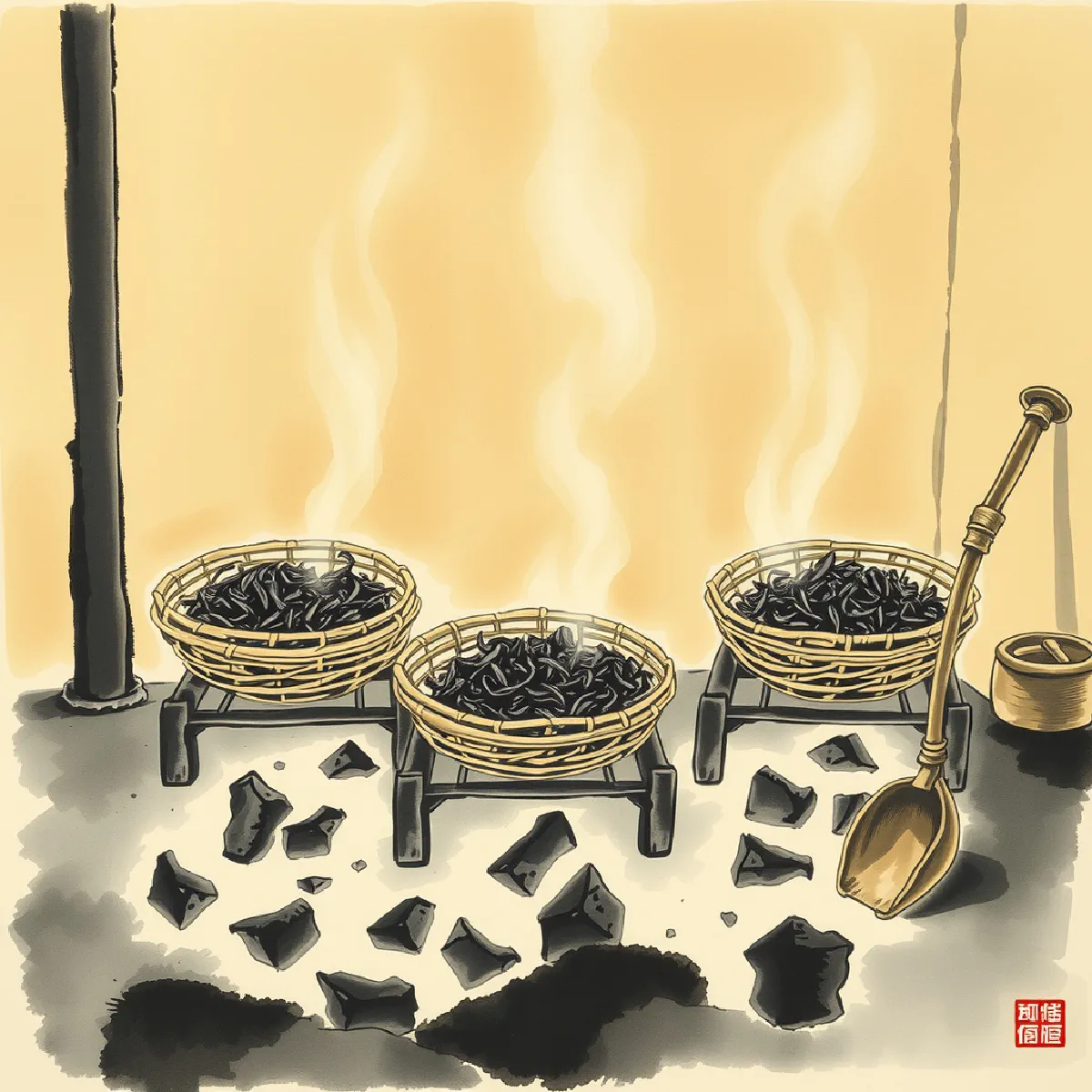
The charcoal itself is prepared first: a large pit’s worth is burned down for up to ten hours until it reaches a clean white-ash state with no visible sparks or black streaks. That bed then radiates usable heat for around twelve days, holding the roasting room somewhere near 50–60°C. Leaves go into bamboo baskets in small batches, a few pounds at a time, for a first pass of ten to twelve hours — with the baskets flipped roughly every half hour so the heat lands evenly, and the maker tasting along the way, waiting for the last of the raw green note to disappear.
Higher-fired teas then go back for additional rounds. This is why genuine charcoal-roasted yancha is expensive, and why electric and infrared roasters — cheaper, far more controllable — now do most of the world’s roasting.
The Part Almost Every Buyer Gets Wrong
Freshly roasted oolong does not taste good. There is a final step, and it happens after the tea leaves the roaster: tui huo (退火), “retreating fire.” The tea rests in sealed clay or bamboo while the raw heat settles and integrates into the body of the tea. Skip it and you get harsh, ashy, one-dimensional tea — and you’ll blame the leaf.
Commonly cited resting windows:
| Roast | Rest before drinking |
|---|---|
| Light | 1–2 months |
| Medium to full | 3–5 months |
| Heavy | Often still improving after 1–2 years |
Two things follow from this. First, if you buy a heavily roasted yancha and it tastes like a campfire, put it away for six months and try again — this is the most reliable free upgrade in tea. Second, when a vendor lists the roast date, that’s a good sign; it means they know you might want to wait.
How to Buy
- New to oolong? Start light or medium. Light roast shows you what the cultivar and the place taste like; heavy roast shows you what the roaster did.
- Want the tea to last in your cupboard? Go medium or higher. Light roast is on a clock.
- Buying Wuyi rock tea? Medium to full is the traditional center of gravity. Look for a stated roast date.
- Chasing “charcoal roasted”? Expect to pay for it, and expect to wait for it.
- Don’t judge from the first session. Roasted oolong changes markedly over the first few infusions and over months in storage.
The simplest way to actually learn this: buy the same tea — same cultivar, same vendor, same year — at two roast levels, and brew them side by side. One session teaches more than any tasting note.