Mengding Ganlu (Sweet Dew - 蒙顶甘露)
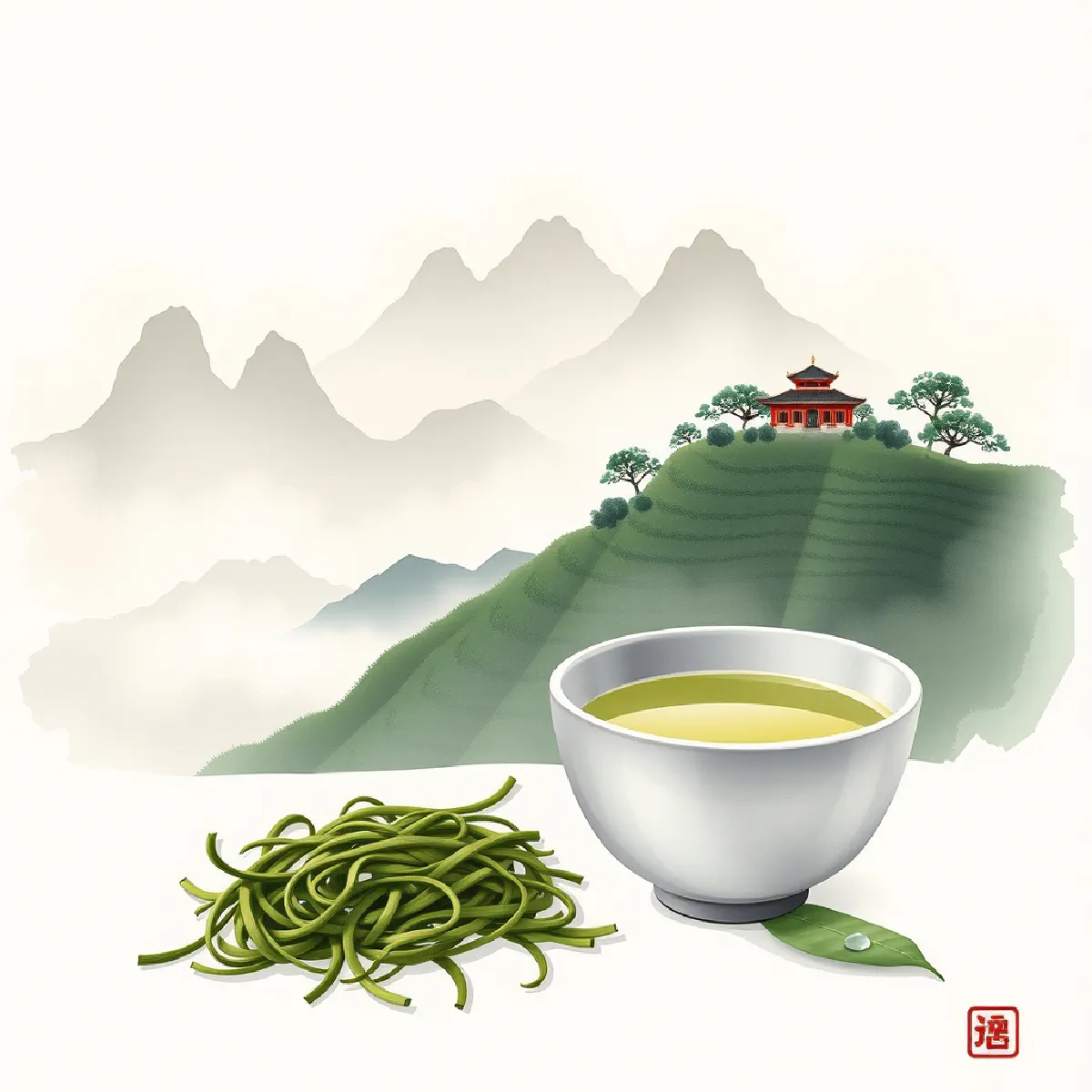
Tea From The Mountain Where Tea Started
Most famous Chinese greens come from the east — Zhejiang, Jiangsu, Anhui. Mengding Ganlu comes from Meng Mountain (蒙山) in Sichuan, west of Chengdu near Ya’an, and it carries a claim none of the others can match: this is traditionally held to be the place where tea was first cultivated rather than gathered wild.
The story credits a Taoist named Wu Lizhen, who is said to have planted seven tea bushes on the mountain around 53 BCE, in the Western Han. Whether the number and date survive scrutiny matters less than the consequence — Meng Shan tea was sent to the imperial court as tribute from the Tang dynasty right through the Qing, one of the longest unbroken tribute runs of any Chinese tea. Buddhist monasteries on the mountain’s five peaks handled the picking. The tea’s name comes from Wu Lizhen’s posthumous Song-dynasty title, Master of Ganlu: “sweet dew.”
For a drinker, the practical takeaway is simpler. Sichuan greens are picked very early — often late February into early March, weeks ahead of Longjing — because the basin warms sooner than the eastern gardens. If you want spring green tea before spring green tea season, this is where you look.
One Mountain, Two Teas
Meng Shan produces both Mengding Ganlu and Mengding Huangya , the yellow tea. Same mountain, same gardens, often the same picking window — the difference is entirely in the workshop.
| Mengding Ganlu | Mengding Huangya | |
|---|---|---|
| Category | Green | Yellow |
| Key step | Repeated wok-roasting with kneading between rounds | An added smothering step (闷黄) after the kill-green |
| Dry leaf | Curly, downy, fine threads | Flat, straight buds, golden-tipped |
| Liquor | Yellow-green, silky | Deeper yellow |
| Character | Orchid aroma, bright, sweet finish | Mellower, corn-sweet, no green edge |
Buying both from the same vendor and the same season is one of the cleanest ways to taste what the yellow-tea smothering step actually does. Very few mountains let you run that experiment.
How It Is Made
The modern method descends from a Ming-dynasty formulation usually written as “three fries, three kneads” (三炒三揉) — though in practice workshops vary, and some accounts describe four rounds in the wok. The principle holds either way:
- Picking — bud, or bud with one very tender leaf, in the cold early morning.
- Kill-green (杀青) — the leaf goes into a hot wok to stop oxidation.
- Alternating kneading and roasting — several rounds. Each pass breaks down leaf tissue and tightens the curl.
- Final baking — low heat to finish and dry.
That repeated kneading is what gives Ganlu its signature look: tightly curled little threads covered in white down, not the flat blades of Longjing or the spirals of Biluochun. It also gives the tea a thicker body than most bud-grade greens — the cell damage means more of the leaf ends up in the cup.
Buying: What to Look For
- Down, and plenty of it. High-grade Ganlu is visibly fuzzy — fine silver-white hairs over tightly curled leaf. Bare, smooth leaf means a later or coarser picking.
- A yellow-green cast is normal. This tea reads more yellow than a Longjing or a Biluochun. Don’t mistake it for age or bad storage.
- Harvest date, not just “spring.” Given the late-February start, a real early-spring Ganlu can be labeled to the week. Vendors who can’t tell you the picking date are guessing too.
- Aroma test. You want clean orchid with a sweet, fruity edge. Sources agree the giveaway for inferior batches is a loud, blunt nutty aroma with a short flat taste — the roast doing the talking instead of the leaf.
- Drink it young. This is a fresh green tea. Buy the current spring, store it sealed and cold, finish it inside a year.
US and international vendors carrying named-origin Mengding Ganlu with harvest dates include Seven Cups, Bitterleaf Teas, and King Tea Mall.
Brewing
Sichuan bud tea is delicate and goes bitter fast. Every source on this tea says the same thing about temperature, and it’s the one number worth getting right.
| Method | Leaf | Temperature | Steeps |
|---|---|---|---|
| Gongfu (gaiwan) | 3 g / 150 ml | 80–85°C | 10–20 s first, +5–10 s per round, 5+ infusions |
| Western (mug) | 2–3 g / 250 ml | 80–85°C | 1–2 min, re-steep twice |
| Glass, grandpa style | 3 g / 300 ml | 80°C | top up as you drink |
Never use boiling water. At 100°C the catechins dump out and the sweet-dew character turns to astringency — this is the single most common way people ruin the tea. If you have no thermometer, boil and then let the kettle stand five to seven minutes, or pour once between two vessels.
The curled leaf also unfurls slowly. Your first gongfu infusion will taste thinner than the second and third; that’s the tea, not a mistake. Let it open.