Yue Guang Bai (Moonlight White - 月光白)
The Odd One Out
Every white tea on this site so far comes from Fujian: Silver Needle, White Peony, Gong Mei, Shou Mei. Yue Guang Bai comes from Yunnan, five hundred miles southwest, and it is made from the same big-leaf trees that produce pu-erh. That single fact explains almost everything strange about it — including why half the shops selling it call it “white pu-erh.”
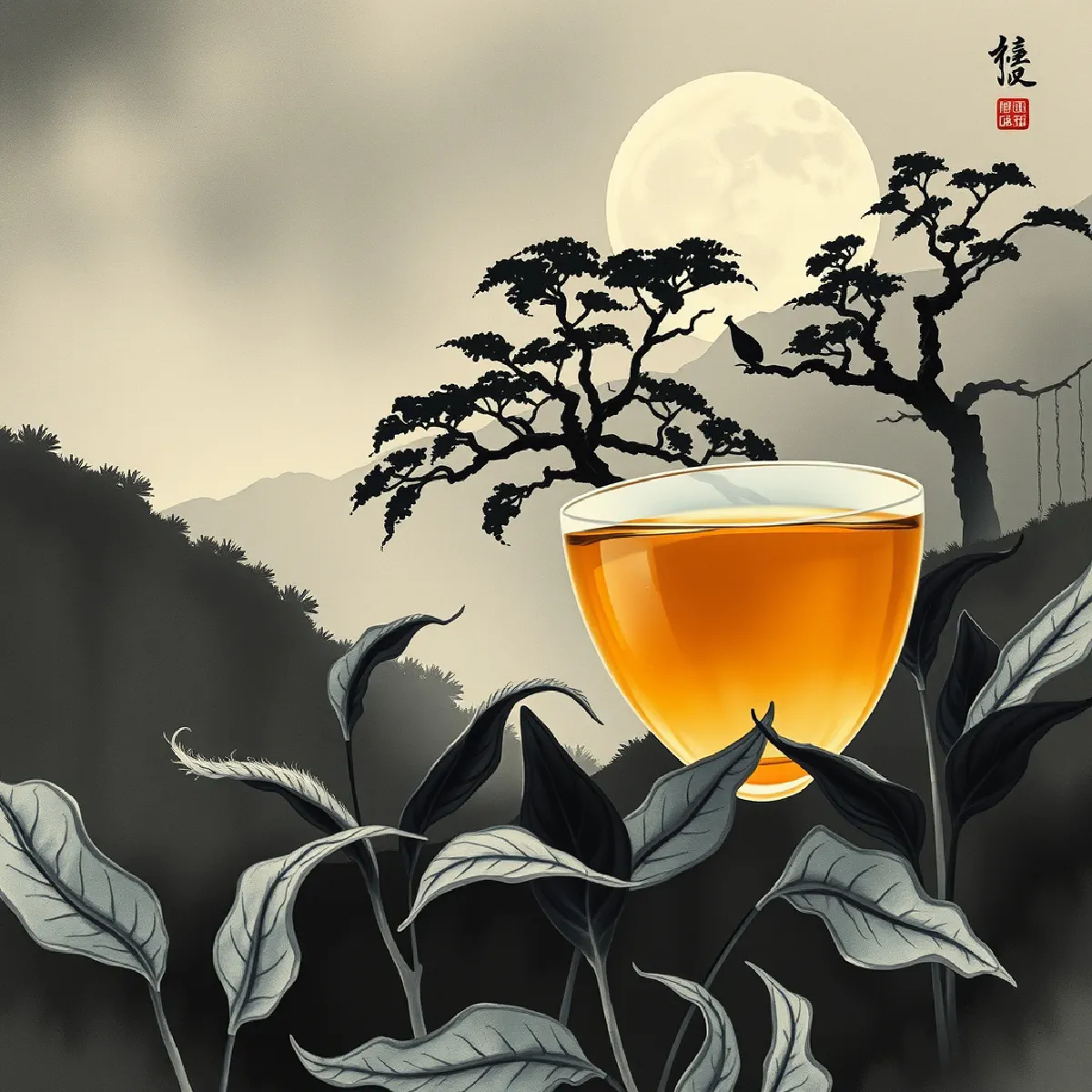
The name means “Moonlight White,” and the leaf earns it. Each piece is two-toned: one face nearly black, the other silver-pale with downy bud hair, so a handful of dry leaf looks like moonlight on dark water. The romantic version of the story says the tea is picked at night and withered under the moon. It is a good story and essentially folklore — nobody harvests a commercial crop by moonlight. What is true is that the wither is deliberately kept out of direct sun, which is where the pale-and-dark contrast actually comes from.
Where It Comes From
Jinggu County in Pu’er Prefecture is the recognized home of Yue Guang Bai, though it is now made across southern Yunnan. The raw material is Yunnan Da Ye (大叶) assamica — the broad-leaf varietal used for pu-erh — rather than the Fujian sinensis cultivars (Da Bai, Da Hao) behind Silver Needle and White Peony.
That varietal difference is not cosmetic. Assamica leaves are larger, thicker, and carry more polyphenols and caffeine, which is why Moonlight White lands heavier in the cup than a Fujian white of the same grade.
How It Is Made
Processing is white-tea processing, with Yunnan modifications:
- Pick — spring harvest, bud plus one or two leaves.
- Wither — indoors or overnight, kept dark, and shorter than a Fujian wither because Yunnan’s climate is warmer.
- Dry — warm air, fully air-dried, often with no final oven roast.
What is absent matters most: there is no kill-green (杀青) fixation step and no rolling. That is the technical reason it is a white tea and not a green tea or a sheng pu-erh — sheng gets a pan-fire fixation and a kneading, Moonlight White gets neither. Shops that label it “white pu-erh” are describing the raw material, not the process.
Because the enzymes are never deactivated, the tea keeps changing in storage — and because the leaf is assamica, it changes toward something darker and maltier than an aged Fujian white, closer in character to a soft red tea after several years.
Moonlight White vs. Fujian White
| Yue Guang Bai | Fujian White (Bai Mudan / Shou Mei) | |
|---|---|---|
| Origin | Jinggu & southern Yunnan | Fuding, Zhenghe (Fujian) |
| Plant | Da Ye assamica (pu-erh trees) | Sinensis — Da Bai, Da Hao |
| Wither | Dark / indoor, no direct sun | Traditionally sun-withered |
| Final dry | Air-dried, often no oven roast | Usually finished with gentle baking |
| Dry leaf | Dramatic two-tone black-and-silver | Uniform green-silver to olive-brown |
| Cup | Honey, malt, apricot, overripe stone fruit, creamy body | Hay, melon, delicate florals, lighter body |
| Strength | Bolder, more caffeine | Gentler, more elegant |
| With age | Darkens toward red-tea character | Deepens into jujube and dried fruit |
If you have tried Fujian whites and found them too faint to hold your attention, Moonlight White is the obvious next step. If you drink young sheng pu-erh and want the fruit without the bitterness and the throat-grip, it works from that direction too.
How to Brew It
Sources differ on temperature mainly because they differ on style. Both of these work:
- Gongfu: 5–7 g per 120–150 ml, 90–95 °C. First steep ~30 s, then 15–20 s, adding 15 s per round. It will give you 7–8 honest infusions, often more.
- Western: 3 g per 250 ml (about 1 g per 100 ml), 85–90 °C, 2–3 minutes.
Two practical notes. The bud hair makes the liquor look slightly cloudy — that is fine, not a flaw. And if you buy it as a compressed dragon ball, do not break it apart; drop the whole ball in a 150 ml-plus vessel and let it unfurl over the first few steeps.
Buying Notes
- Look for whole bud-and-leaf sets with the two-tone contrast clearly visible. Uniformly dark, broken, dusty leaf is lower grade or badly stored.
- Treat the label loosely. “White pu-erh,” “Yunnan white,” and “Moonlight White” are all sold as the same thing. Ask what county and what year.
- Don’t assume it will age. Makers use different drying strategies and not every batch is built for storage. If aging is the point, buy from a vendor who says so specifically and keep it dry, dark, and away from odors.
- Where to find it: Yunnan Sourcing, Seven Cups, white2tea, and Bitterleaf all carry Yunnan white tea; it is a Yunnan specialty, so Yunnan-focused shops carry the deepest selection.
Start with 25–50 g of a recent spring harvest before committing to a cake. Moonlight White is sweet and forgiving enough that a first session rarely goes wrong — which, for a tea this unusual-looking, is a pleasant surprise.