Breaking a Pu-erh Cake (撬茶): The Tool, the Angle, and the Jar
The Problem Nobody Warns You About
You buy your first pu-erh cake, get it home, and discover that 357 grams of tea have been pressed into something with roughly the density of particleboard. The sachet of loose leaf you’re used to doesn’t prepare you for this. So you attack it with a steak knife, and what ends up in your gaiwan is a pile of shredded fragments that brew harsh and muddy.
The leaves weren’t bad. The technique was. Compressed tea is built in layers, and the whole job is getting between those layers instead of cutting through them.
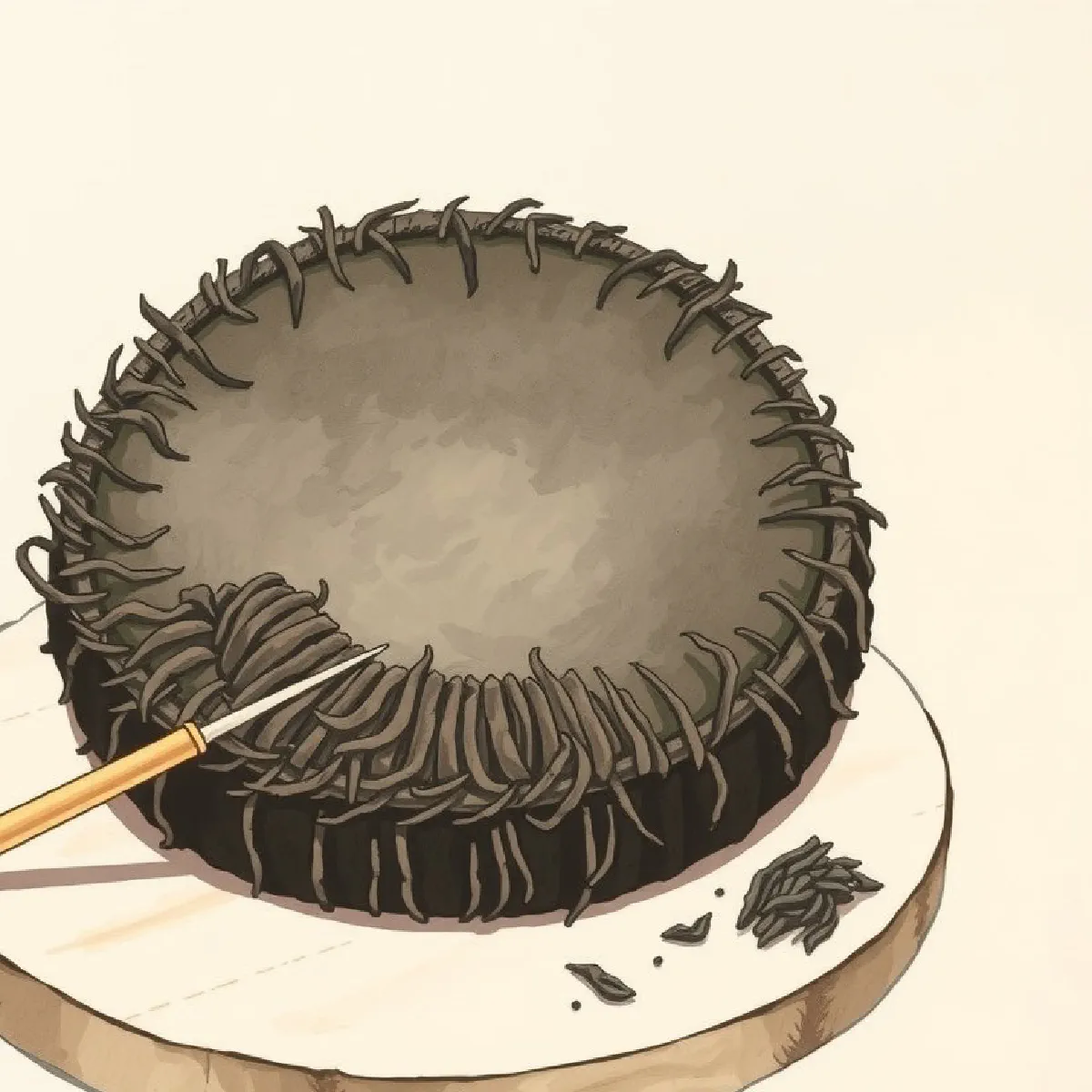
Pick the Right Tool
The tool you want is blunt-bodied and sharp only at the tip. You are wedging, not slicing — a point to start the gap, a shaft stiff enough to lever it open.
| Tool | Best for | Notes |
|---|---|---|
| Tea pick / needle (茶针) | Cakes, tuocha | The default. Narrow, pointed tip, wooden handle for grip |
| Tea knife (茶刀) | Bricks, hard-pressed cakes | Flat blade, dull edges — peels layers rather than cutting |
| Ice pick | Dense tuocha | Narrow like a tea needle but much more rigid |
| Butter knife | Emergencies | Works; just slow. Blunt is the point |
What not to use: a sharp kitchen knife. It shreds the leaf, and it’s the one tool in this list that will actually hurt you when it slips. A dull flathead screwdriver is a safer improvisation than a paring knife.
The Method
1. Put the cake on a stable surface. A board or tray, not your palm. Keep your free hand flat on top of the cake, well away from where the tip is going.
2. Go in from the side. This is the step that separates clean chunks from dust. Insert the tip into the narrow edge of the cake, roughly horizontal, aiming toward the dimple at the center. You’re sliding between pressed layers. Pushing straight down through the face does the opposite — it punches across them.
3. Work in about half an inch and lever gently. Jiggle the handle up and down a little. You’ll feel the cake flex.
4. Repeat around the circumference. Pull the tool out, move an inch or two along the edge, go in again. After four or five spots the whole thing loosens noticeably.
5. Finish with your hands. Once a seam opens, slide your fingers in and pull sideways. Hand-separated chunks keep their leaf strands intact; tool-separated ones rarely do.
By shape
- Cake (饼茶) — start at the edge, or at the small indentation on the back called the bō wō (拨窝), which is usually pressed less tightly than the rest.
- Brick (砖茶) — forget the flat faces. Work the four narrow sides and peel off layers.
- Nest (沱茶) — begin inside the hollow bowl underneath and spiral outward. Tuocha is often the hardest-pressed shape of the three; this is where an ice pick earns its place.
Throughout: point the tool away from your hand and your body, and use steady pressure rather than stabbing. The injuries happen on the jab that slips.
How Much to Break, and Where to Put It
A gongfu session is roughly 5–7g, so a sensible habit is to break off a week or two of drinking at a time — enough that you’re not wrestling the cake every morning, not so much that you’ve committed the whole thing.
Put those chunks somewhere breathable: a clay jar with a loose-fitting lid, a cardstock box, even a paper bag. Not an airtight canister — pu-erh is a living tea and wants a little air. The rest of the cake goes back in its original wrapper, somewhere cool, dark, and far from anything aromatic. See our storage guide for the longer version.
The side effect worth knowing about
Breaking a cake up doesn’t just make it convenient — it changes the tea. Compressed, only the outer leaves meet much oxygen, so a cake ferments unevenly from the surface inward. Break it into chunks and you expose everything at once.
Drinkers call this 醒茶 (xǐng chá), “waking the tea,” and the effect is quick: tea that’s sat broken in a jar for as little as three weeks often brews brighter and more evenly than it did straight off the cake. It’s one of the cheapest improvements available to you — it costs nothing but shelf space.
The trade-off is real, though. That same oxygen exposure spends the cake’s long-term aging potential. A compressed cake left alone for ten years will go further than a jar of chunks will. So: break up what you intend to drink this season, and leave what you’re aging pressed.
Try It on the Cheap One First
If you have a cake you care about, don’t learn on it. Buy an inexpensive shu pu-erh — the kind that comes in at a few dollars for 100g — and take it apart badly a couple of times. You’ll feel the difference between pushing through the leaves and sliding between them within about five minutes, and after that the expensive cake is safe.
Sources: white2tea — How to Break Apart a Puer Cake , Oriental Leaf — How to Break a Chinese Tea Cake Safely , Global Tea Hut Archive — Broken Cake Puerh Storage , Steepster — Pu’erh Pick or Pu’erh Knife? , and Puerh.fr — Put in Jar a Puerh Tea Cake .