Grandpa Style Brewing (玻璃杯泡茶): Leaves in a Glass, All Day Long
How Most of China Actually Drinks Tea
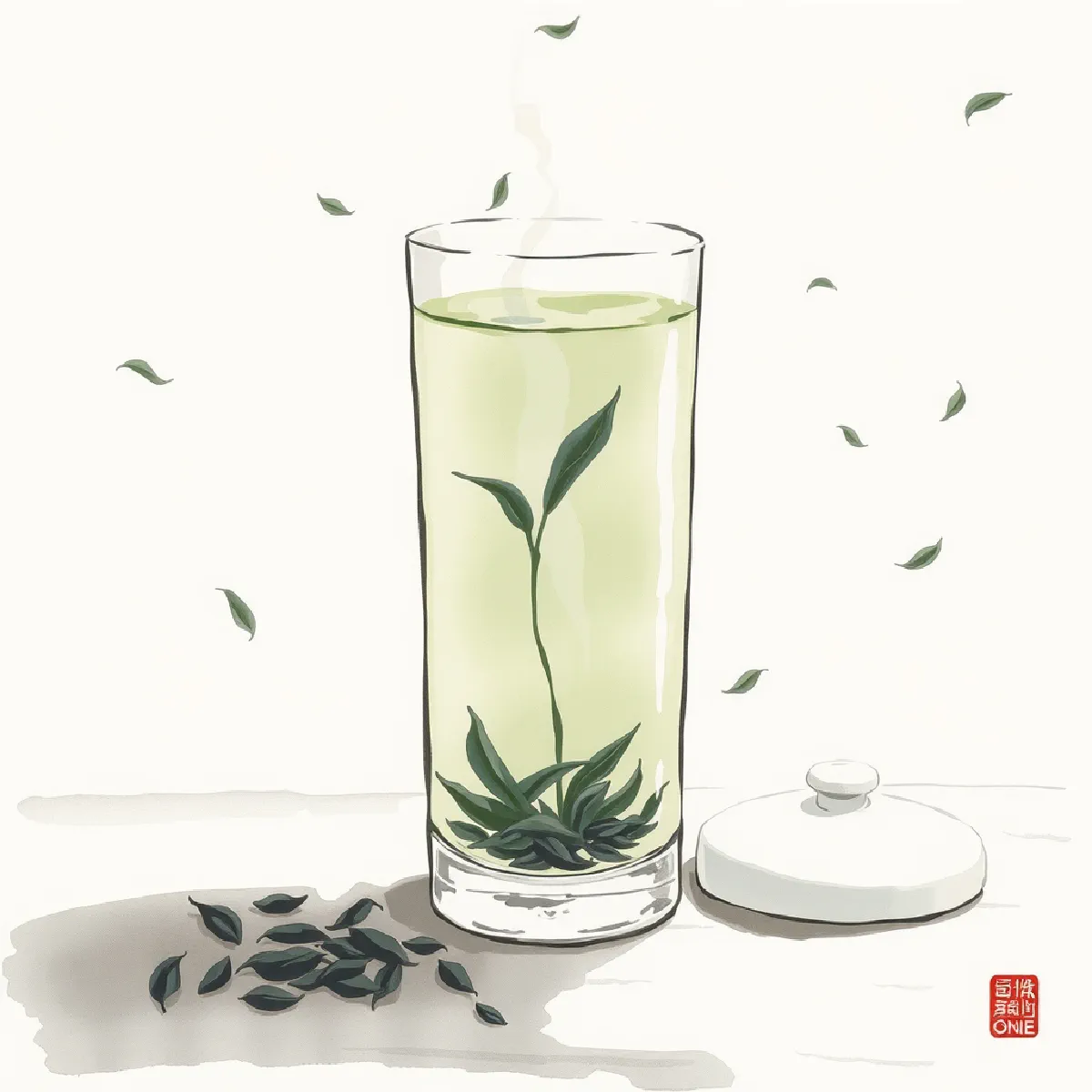
Put a pinch of leaves in a tall glass. Pour hot water on top. Drink. When the glass runs low, top it up. Repeat until the leaves give out, somewhere around mid-afternoon.
That’s the whole method. The tea blogger MarshalN named it grandpa style after his grandfather, and the name stuck in English-language tea writing. In China it has no special name — it’s simply 泡茶, making tea. Sit in a Chinese taxi and there’s a good chance the driver has a glass jar of leaves and water in the cupholder. Gongfu brewing gets the photographs; this is what people actually do on a Tuesday.
Why It Doesn’t Turn Bitter
Leaves sit in water for hours. By gongfu logic that should be undrinkable. Three things save it.
The ratio is low. You’re using roughly a third of what you’d pack into a gaiwan. Less leaf means the water reaches a drinkable equilibrium instead of a punishing one.
The leaves settle. Dry leaf floats, rehydrates, gets denser, and sinks within two or three minutes. The strong liquor sits down at the leaf bed; what reaches your lips from the top of the glass is lighter.
Every refill dilutes. You never remove the leaves, so extraction never stops — but you’re not re-steeping either. Topping up thins what’s already there. Strength is managed by dilution, not by timing.
There’s chemistry underneath it: catechins, caffeine, and gallic acid come out fast and then plateau, approaching equilibrium rather than climbing forever. A twenty-minute steep is not four times as harsh as a five-minute one.
The Method
Leaf: about 2–4g per 300ml — enough to cover the bottom of the glass, no more. Don’t measure. The Chinese convention for glass-brewed green is slightly stronger at 1:50, roughly 3g in a 200ml glass. Start light; you can always add a pinch later.
Vessel: clear glass, 250–350ml or larger. Glass earns its place twice over — you get to watch the leaves open, and you can see where they are so you don’t inhale them. A lid helps hold heat and aroma.
Water: 80°C for green and delicate white, boiling for roasted oolong, aged tea, and shou pu-erh. This is where sources split. Some experienced drinkers disregard temperature entirely and the low ratio carries them; others still drop to 80°C for green. If your green tastes rough, cool the water before you cut the leaf.
Fill to 70% (七分满), not to the brim. Room to tilt, room to top up.
Top up at the one-third mark. This is the one rule worth obeying. Drink about two-thirds, then refill, leaving the remaining third as a flavor base for the next round. Let the glass go empty and the next fill hits bare, over-extracted leaves. Pour from a height down the side of the glass to stir the layers together.
Drinking around the leaves: your teeth and lips are the filter. A slight pucker holds most of them back. If one gets through, it’s a tea leaf — chew it or put it back. This is the method’s honest drawback, and no technique eliminates it.
The Three Throws
Chinese practice has a vocabulary for glass brewing that English tea writing almost never mentions: how you combine leaf and water depends on the leaf.
| Method | How | Best for |
|---|---|---|
| 上投法 (upper throw) | Fill glass 70% with water first, drop leaves on top | Downy, fragile buds — Biluochun , Xinyang Maojian |
| 中投法 (middle throw) | Pour 1/3 water, add leaves, let them soften, fill to 70% | Flat or tightly shaped delicate green — Longjing , Anji Baicha |
| 下投法 (lower throw) | Leaves first, then water to 70% | Larger, sturdier leaf — Taiping Houkui , Lu’an Gua Pian |
The lower throw is the default, and it’s what Western writing calls grandpa style. The other two exist because a hard pour onto fragile buds bruises them.
Which Teas Work
| Tea | Verdict |
|---|---|
| Big-leaf green (Longjing, Houkui, Gua Pian) | Excellent — the classic use |
| White tea (Silver Needle, Bai Mudan) | Excellent — forgiving, sweet, lasts for hours |
| Roasted or aged oolong (yancha, aged Dong Ding) | Excellent — the experienced drinkers’ pick |
| Shou pu-erh, aged tea | Good, but rinse the leaf first |
| Whole-leaf Chinese red (Dianhong ) | Workable, use a light hand |
| Rolled green oolong (Tieguanyin) | Contested — releases unevenly, try it before committing a day to it |
| Japanese sencha, gyokuro | Avoid — fine cut, won’t settle |
| CTC, fannings, broken leaf, tea-bag grade | Avoid — grit in your mouth, harsh in the cup |
The pattern is simple: whole leaf that sinks, good. Small particles that stay suspended, bad.
The Thermos Question
Western vendors treat the vacuum flask as grandpa style’s travelling sibling, with dosing tables and all. Chinese tea writing is largely against it, and the objection is specific: a sealed flask holds near-boiling heat for hours, which 闷 (stews) the leaf, driving out polyphenols and caffeine into something over-strong and astringent while cooking off the aroma.
Both camps are partly right, and they’re aiming at different teas. The pro-thermos advice leans on ripe pu-erh, aged tea, and roasted oolong, which tolerate sustained heat. The Chinese objection targets green tea, which doesn’t. If you want green tea in a flask, brew it in a glass and decant the strained liquor into the thermos.
Try It Tomorrow
Find the tallest clear glass in your kitchen. Add enough Longjing or Bai Mudan to cover the bottom, pour 80°C water to the seven-tenths line, and leave it on your desk. Top it up at a third. You’ll get four hours of tea out of three grams of leaf and learn something about how your leaf behaves over time that no thirty-second gongfu steep will tell you.
One housekeeping note: specialist sources don’t address leaving leaves in overnight, and general food-safety advice says don’t. Dump the spent leaf at the end of the day and start fresh.
Sources: MarshalN — What’s Grandpa Style? , Tea for Me Please — Grandpa Style Tea Brewing , Northern Teaist — Grandpa Style , T Ching — Brewing Grandpa Style , White2Tea — Grandpa Style and Thermos Tea , Mei Leaf — Brewing Hou Kui Grandpa Style , Path of Cha — What Is Grandpa Style Tea , Morima Tea — Shang Tou Fa, Zhong Tou Fa and Xia Tou Fa , and Nutrition Journal — Kinetics of tea infusion .